What Makes a Qualified Full Stack AI Engineer?
A practical breakdown of the skills a full stack AI engineer needs — from models and data to backend, frontend, and production.
Introduction
A full-stack AI engineer is a software engineer who builds complete, end-to-end AI applications, combining traditional front-end and back-end development with machine learning and LLM orchestration.
Traditional full-stack developers focus on user interfaces and databases, while data scientists mainly train and analyze models. A full-stack AI engineer bridges the entire pipeline: they take an AI product from raw data or model selection all the way to a polished, production-ready user interface.
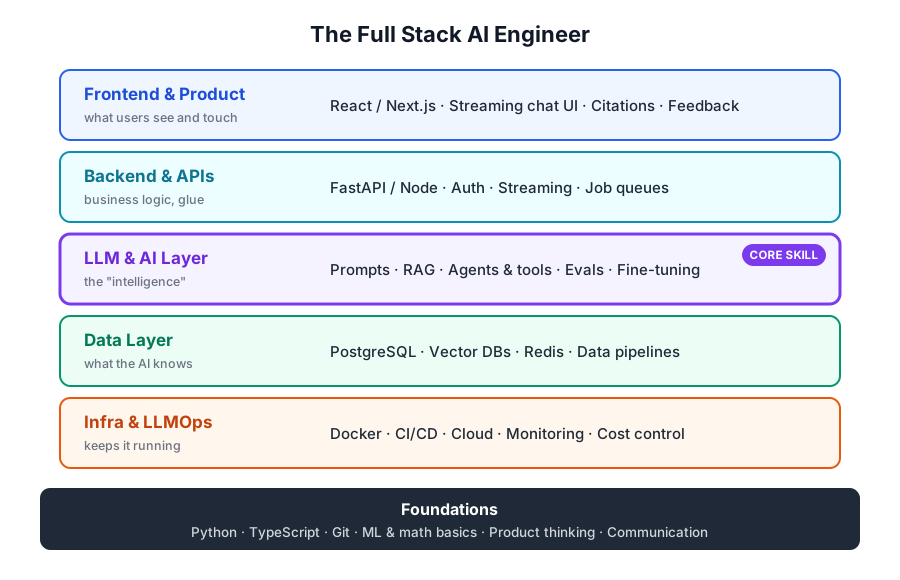 The five layers of an AI product, sitting on a shared foundation
The sections below walk through each layer, in roughly the order you should learn them. The conclusion turns them into a month-by-month roadmap.
1. Software Engineering Foundations
AI engineering is software engineering first. Most AI projects fail on the “boring” parts (bad APIs, no tests, messy code), not on the model.
- Python, the language of AI work: typing,
async/await, virtual environments, packaging (uvorpip) - JavaScript / TypeScript, the language of the web
- Git and GitHub: branches, pull requests, code review
- The Linux command line and basic networking: HTTP, REST, JSON
- Testing:
pytestor Jest, and writing code others can maintain - Just enough math: linear algebra (vectors and dot products are the basis of embeddings), probability, and basic statistics
If you can already build and ship a small web app with tests, you can skim this section and move on.
2. Machine Learning & Deep Learning Fundamentals
You don’t need to be a researcher, but you do need intuition. Without it, you can’t tell whether a bad result is a prompt problem, a data problem, or a model limitation.
- Core ideas: supervised vs. unsupervised learning, training vs. inference, overfitting, evaluation metrics
- Tools: NumPy, pandas, scikit-learn, then PyTorch basics
- How transformers work at a conceptual level: tokens, attention, context windows, embeddings
- Good resources: Andrew Ng’s courses, fast.ai, and Andrej Karpathy’s Neural Networks: Zero to Hero videos
Don’t skip this phase. It only takes 1–2 months, and it pays off every time a model behaves in a way you don’t understand.
3. LLMs and Generative AI
This is the heart of the role, and where you should spend the most time.
Model APIs and prompting
- Model APIs from Anthropic, OpenAI, and Google: structured outputs, streaming, tool/function calling
- Prompt engineering: system prompts, few-shot examples, output formatting, prompt caching
- Frameworks: learn the raw APIs first, then LangChain / LangGraph, LlamaIndex, or the Claude Agent SDK. Knowing what a framework abstracts away makes debugging much easier.
RAG (Retrieval-Augmented Generation)
RAG lets a model answer questions using your data without retraining it. It has two halves: an offline indexing step and an online query step.
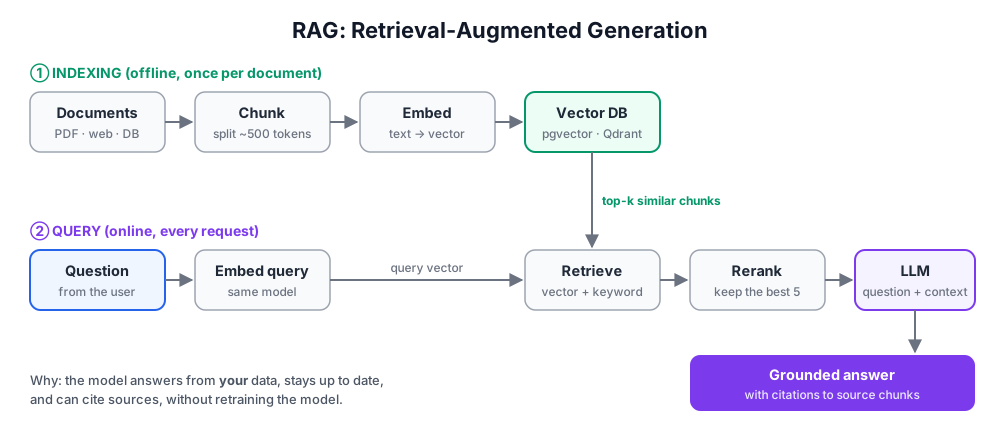 Indexing happens once per document; retrieval happens on every question
Skills to learn: chunking strategies, embedding models, vector search (pgvector, Qdrant, Pinecone), hybrid search (vector + keyword), and reranking.
Agents and tool use
An agent is an LLM that calls tools in a loop: it decides on an action, runs a tool, reads the result, and repeats until the goal is met.
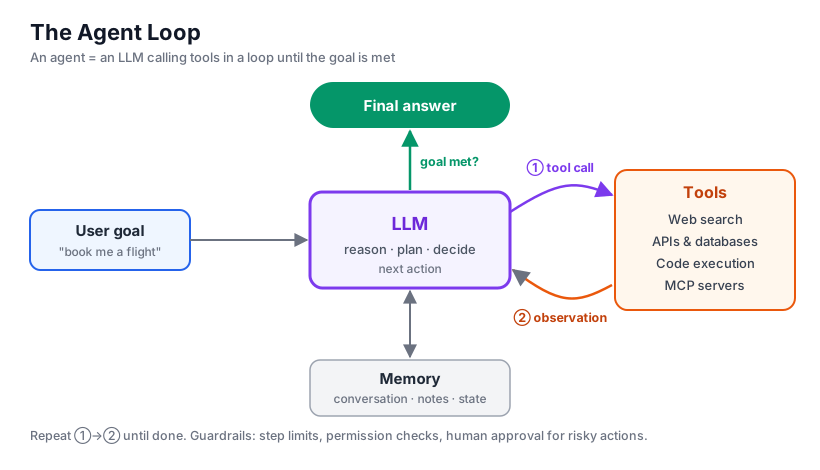 The model plans, the tools act, and memory keeps track of state
Skills to learn: tool definitions, planning, memory, MCP (Model Context Protocol) for connecting tools, multi-agent patterns, and guardrails such as step limits and human approval for risky actions.
Evaluation: what separates hobbyists from professionals
Most people can call an API. Few can prove their system works. Evals are that proof.
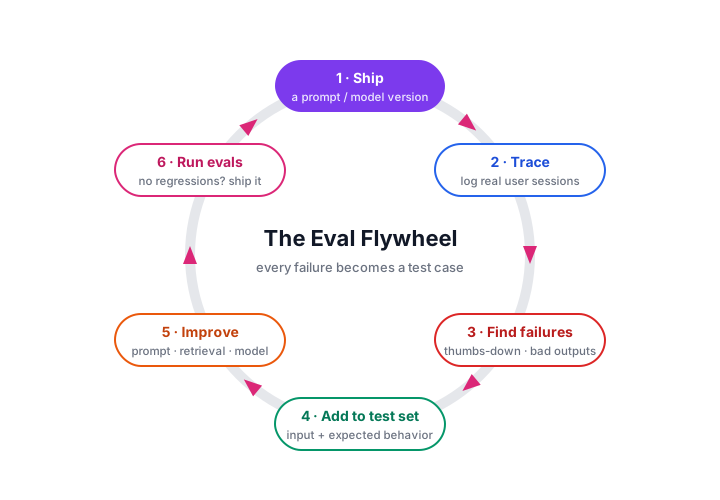 Every failure you find in production becomes a new test case
- Test sets: realistic inputs plus the expected behavior
- LLM-as-judge for grading open-ended outputs
- Regression testing: run evals on every prompt or model change before shipping
- A/B testing in production
Open models and fine-tuning
- Hugging Face, running models locally with Ollama or vLLM, quantization basics
- Fine-tuning (LoRA / QLoRA) when prompting and RAG aren’t enough. It’s a specialization, so learn it later.
4. Data Engineering
An AI product is only as good as the data behind it.
- PostgreSQL: the most important database to know well, with solid SQL fluency
- Vector stores: pgvector (inside Postgres), Qdrant, or Pinecone
- Redis: caching and job queues
- Data pipelines: ingesting, cleaning, and chunking documents; keeping indexes up to date
- Data quality: deduplication, handling PII, versioning your eval datasets
5. Backend & APIs
The backend is the glue: it receives user requests, runs the RAG or agent logic, calls the model, and streams the answer back.
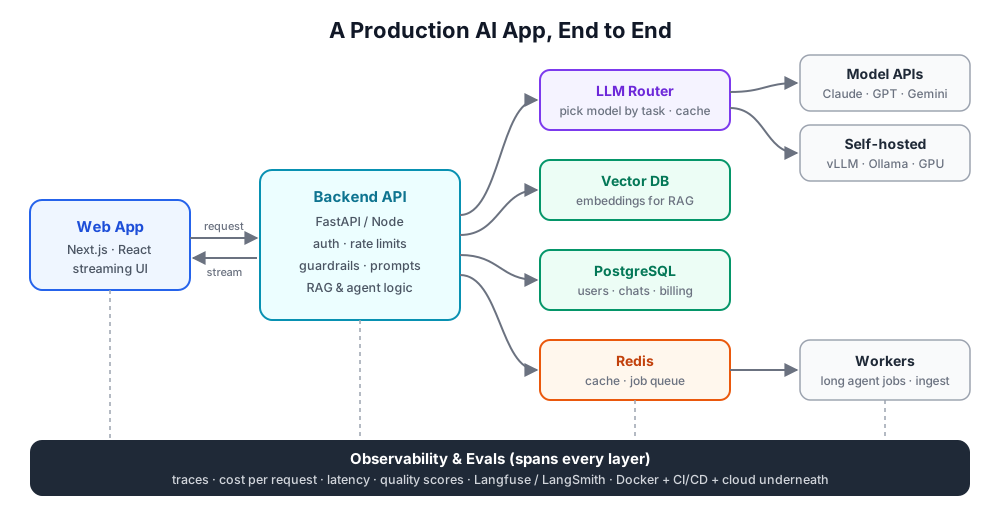 A typical production AI app: every layer from the diagram at the top, wired together
- Frameworks: FastAPI (Python) or Node with Express / Hono
- Streaming responses (Server-Sent Events or WebSockets), since nobody wants to wait 20 seconds for a full answer
- Auth, rate limiting, and usage limits per user
- Background jobs (Celery, BullMQ) for long-running agent tasks and document ingestion
- Cost and latency control: response caching, model routing (small models for easy tasks), batching, token budgets
- Guardrails: prompt injection defense, output validation, PII handling
6. Frontend & Product
Users judge an AI product by how it feels.
- React with Next.js, Tailwind, and state management
- Streaming chat UIs: token-by-token rendering, stop and retry buttons, markdown and code rendering
- Trust features: citations, showing sources, showing what the agent is doing
- Feedback loops: thumbs up/down and “report a problem” buttons, which feed straight into your eval set
7. MLOps / LLMOps & Deployment
- Containers and CI/CD: Docker, GitHub Actions
- Cloud: pick one of AWS, GCP, or Azure and learn it well
- Hosting: Vercel or Railway for shipping fast; Kubernetes basics for scale
- Model serving: GPU inference, vLLM, serverless GPU platforms (Modal, Replicate)
- Observability: trace every LLM call with Langfuse, LangSmith, or Arize Phoenix, and track cost per request, latency, and quality scores over time
8. Soft Skills
- Product thinking: knowing when AI is the right tool, and when a simple rule or a database query is better
- Communication: explaining what the system can and can’t do to non-technical people, honestly
- Learning speed: the field changes monthly. Follow a few good sources (company engineering blogs, Simon Willison, Latent Space) instead of chasing every new framework.
- Building in public: GitHub, a blog, LinkedIn. In this field, a portfolio often outweighs credentials.
Conclusion
A full stack AI engineer is a strong software engineer who understands models well enough to build reliable products around them. Here is the whole path as a roadmap, assuming about 15–20 hours of study a week:
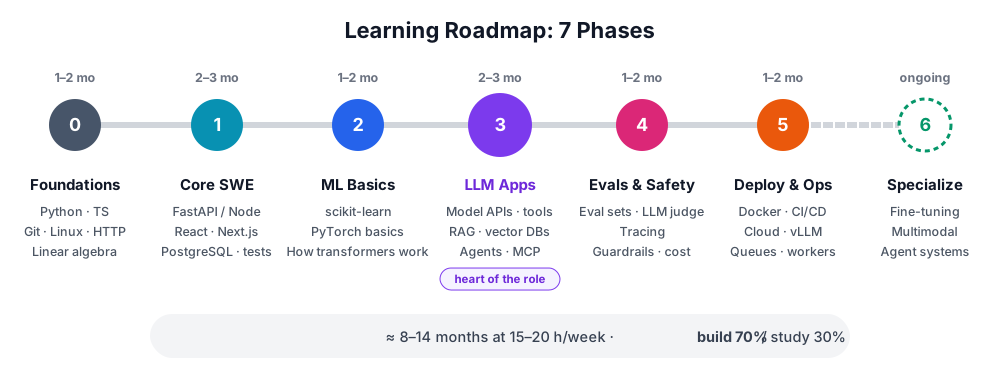 Phase 3 (LLM applications) is the core of the role
| Phase | Focus | Time |
|---|---|---|
| 0 | Foundations: Python, TypeScript, Git, math | 1–2 months |
| 1 | Core software engineering: backend, frontend, databases | 2–3 months |
| 2 | ML fundamentals | 1–2 months |
| 3 | LLM applications: APIs, RAG, agents | 2–3 months |
| 4 | Evals, reliability, and safety | 1–2 months |
| 5 | Deployment and MLOps | 1–2 months |
| 6 | Specialize: fine-tuning, multimodal, or agent systems | ongoing |
Projects that prove your skills
Build these end to end, deploy them, and write a good README for each:
- Chat-with-your-docs app: a RAG pipeline plus a streaming UI, with citations
- Agent with tools: for example a research or booking assistant that calls real APIs, using MCP
- Eval harness: measure how prompt or model changes affect quality, and publish the results
- Production-grade SaaS: auth, billing, usage limits, observability, and cost tracking. This is the one that impresses hiring managers most.
Build more than you study, roughly 70% building and 30% learning. And remember: evals are your edge.