Deep Learning CT Reconstruction From Incomplete Projection Data
A comprehensive review of deep learning methods for CT reconstruction from incomplete projection data, covering sparse-view, limited-angle, metal artifact reduction, and ring artifact problems.
Original link: A Review of Deep Learning CT Reconstruction From Incomplete Projection Data
📄 Abstract
This article provides a comprehensive overview of the current state-of-the-art DL-based CT Reconstruction from incomplete projection data, including 5 problems:
- Sparse view reconstruction
- Limited angle reconstruction
- Metal artifact reduction
- Interior tomography
- Ring artifact reduction
🔬 Ⅰ. Introduction
The quality of the reconstructed images from CT scans is directly influenced by the completeness of the measured data. Accurate CT images can be reconstructed from complete projection data using classic analytical or iterative reconstruction methods. However, complete projection data may not be available in practice, due to factors such as radiation dose limitations, space and time constraints, object shape, and imaging system limitations.
Before deep learning, early methods for incomplete projection data reconstruction fell into two categories:
- Projection data completion methods — start from the projection data and use known information to estimate missing data
- Iterative reconstruction methods — formulate an objective function based on observation and prior knowledge of CT images, then optimize
In recent years, a wide variety of DL-based methods have emerged and brought new solutions to incomplete projection data reconstruction.
🩻 Ⅱ. Causes of Incomplete Projection Data
In parallel-beam imaging systems:
- Full scan: 360° scanning angle
- Half scan: 180° — the minimum angle required for accurate reconstruction
In fan-beam imaging systems, the half-scanning range is 180 + w°, where w is the field angle of the fan beam.
This survey uses the fan-beam scanning system as the primary example, since fan-beam is more realistic and more commonly studied in clinical practice.
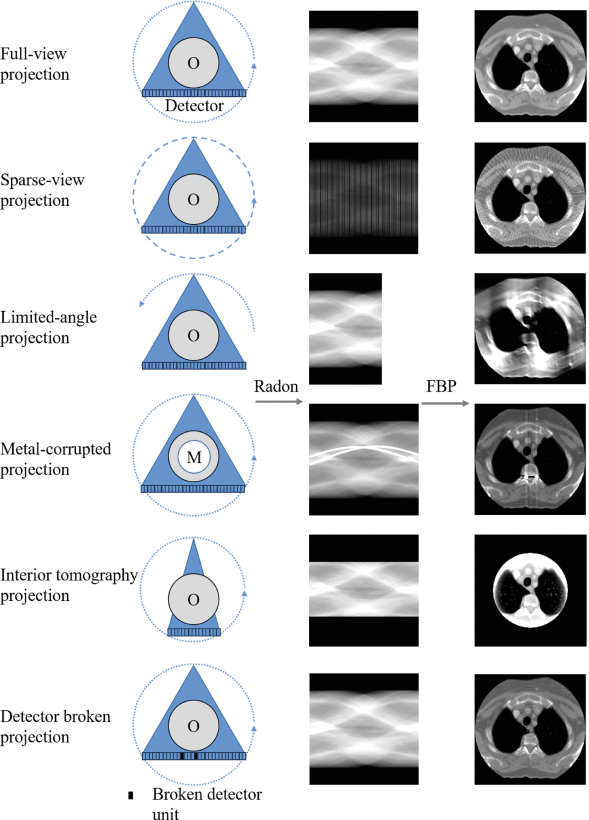
A. Incomplete Sampling View Problem
Two sub-problems:
Sparse View (SV) Sampling — only part of the projection data within the full scan range is obtained. Used to reduce radiation exposure. Also shortens scanning time and reduces motion artifacts from heartbeat and respiratory motion. Side effect: streak artifacts introduced into the reconstructed image.
Limited Angle (LA) Sampling — similar data incompleteness, but due to angular range limitations rather than angular density.
Streak artifacts from sparse-view sampling can impair important clinical details. The goal of DL methods is to suppress these artifacts while preserving diagnostic information.
B. Metal Implant Problem
Content coming soon.
C. Interior Problem
Content coming soon.
D. Ring Artifact Problem
Content coming soon.
🤖 Ⅲ. Review of Current Deep-Learning-Based Methods
A. Different Domain Learning
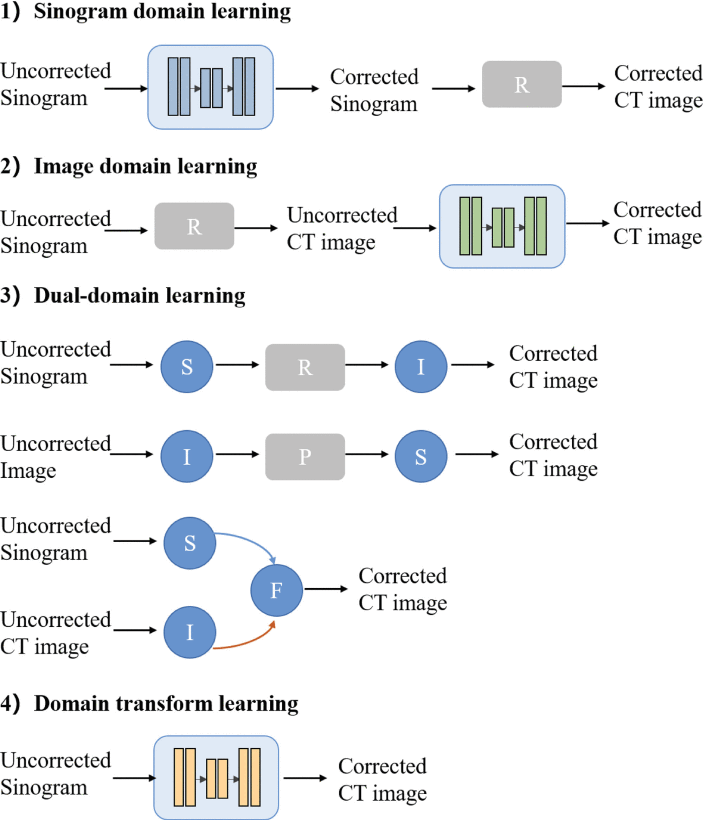
DL-based methods can be classified into four distinct groups based on the data domains they operate in:
flowchart TD
    DL["🤖 DL-Based CT Reconstruction"]:::root
    DL --> SIN["📡 Sinogram Domain\nLearning"]:::dom
    DL --> IMG["🖼️ Image Domain\nLearning"]:::dom
    DL --> DUAL["🔁 Dual-Domain\nLearning"]:::dom
    DL --> TRANS["🔄 Domain Transformation\nLearning"]:::dom

    classDef root fill:#4A90D9,stroke:#2c5f8a,color:#fff
    classDef dom fill:#5BA85A,stroke:#3a6e39,color:#fff
| Domain | Strength | Limitation |
|---|---|---|
| Sinogram Domain | Direct access to raw measurements | Secondary artifacts easily introduced |
| Image Domain | Works with familiar image representations | Hard to recover lost raw data information |
| Dual-Domain | Combines both domain strengths | More complex to train |
| Domain Transformation | End-to-end mapping | Requires high-quality paired training data |
Dual-domain networks are integrated to effectively extract information from both sinogram and image domains and complement each other’s weaknesses.
B. Unsupervised and Semi-Supervised Learning
Content coming soon.
📊 Ⅳ. Evaluation
A. Dataset
- DeepLesion
- Spineweb Dataset 3
- AAPM
- CTPelvic1K
B. Deep Reconstruction Tools
| Tool | Use |
|---|---|
| ASTRA Toolbox | Forward/back projection operators |
| ODL | Operator Discretization Library |
| TorchRadon | GPU-accelerated Radon transform in PyTorch |
| NeuTomPy Toolbox | Neutron and X-ray tomography |
| CTLib | CT reconstruction utilities |
| TomoPy Toolbox | Synchrotron tomography |
C. Artifacts Reduction Performance
Content coming soon.
D. Stability Performance
Content coming soon.
🔮 Ⅴ. Conclusion and Future Works
Content coming soon.
Part of my CT reconstruction paper review series. Next: specific DL architectures for sinogram-domain artifact reduction.