CT Reconstruction by Deep Learning
A technical overview of deep learning reconstruction (DLR) algorithms for CT imaging, comparing FBP, iterative reconstruction, and DLR approaches with clinical applications.

Original link: Deep Learning Image Reconstruction for CT: Technical Principles and Clinical Prospects
📋 Abbreviations
| Abbreviation | Full Term |
|---|---|
| CNN | Convolutional Neural Network |
| DLR | Deep Learning Reconstruction |
| FBP | Filtered Back Projection |
| IR | Iterative Reconstruction |
| HIR | Hybrid IR |
| MBIR | Model-Based IR |
💡 Summary
The clinical introduction of DLR algorithms over the past 5 years has demonstrated the potential of DLR to:
- Rapidly reconstruct images with low noise and desired noise texture
- Preserve spatial resolution
- Reduce radiation dose up to 71%
DLR represents a paradigm shift in CT reconstruction — it doesn’t just denoise images, it learns to reconstruct them better from fewer measurements. Up to 71% dose reduction is clinically significant for vulnerable populations (pediatrics, frequent imaging patients).
⭐ Essentials
- DLR algorithms can be applied in the raw data domain, image domain, or both
- Compared with FBP and HIR, DLR provides improved image quality
- DLR potentially allows radiation dose reductions between 30% and 71% vs HIR, while maintaining diagnostic quality
- Deep learning-based metal artifact reduction (MAR) outperforms current state-of-the-art MAR methods
📈 Evolution of Image Reconstruction
flowchart LR
    FBP["⚡ FBP\n(Fast, noisy)"]:::stage --> HIR["🔁 Hybrid IR\n(Better quality)"]:::stage --> MBIR["🔬 MBIR\n(Best quality, slow)"]:::stage --> DLR["🤖 DLR\n(Fast + best quality)"]:::stage

    classDef stage fill:#4A90D9,stroke:#2c5f8a,color:#fff
Filtered Back Projection (FBP)
FBP is the most commonly used reconstruction technique due to its computational efficiency and numeric stability. However, when radiation dose is reduced or larger patients are scanned, FBP’s limitations become evident: higher noise and more artifacts.
Model-Based Iterative Reconstruction (MBIR)
MBIR is the most computationally demanding IR type. It uses multiple iterations of forward and back projections between the sinogram domain and image domain to optimize image quality. The more complete model allows for greater noise and artifact reduction than FBP — but high computational requirements and long reconstruction times have limited widespread clinical application.
Hybrid Iterative Reconstruction (HIR)
HIR consists of iterations in the sinogram domain, one back projection, and more iterations in the image domain. Less computationally demanding than MBIR, but also less capable of noise and artifact reduction.
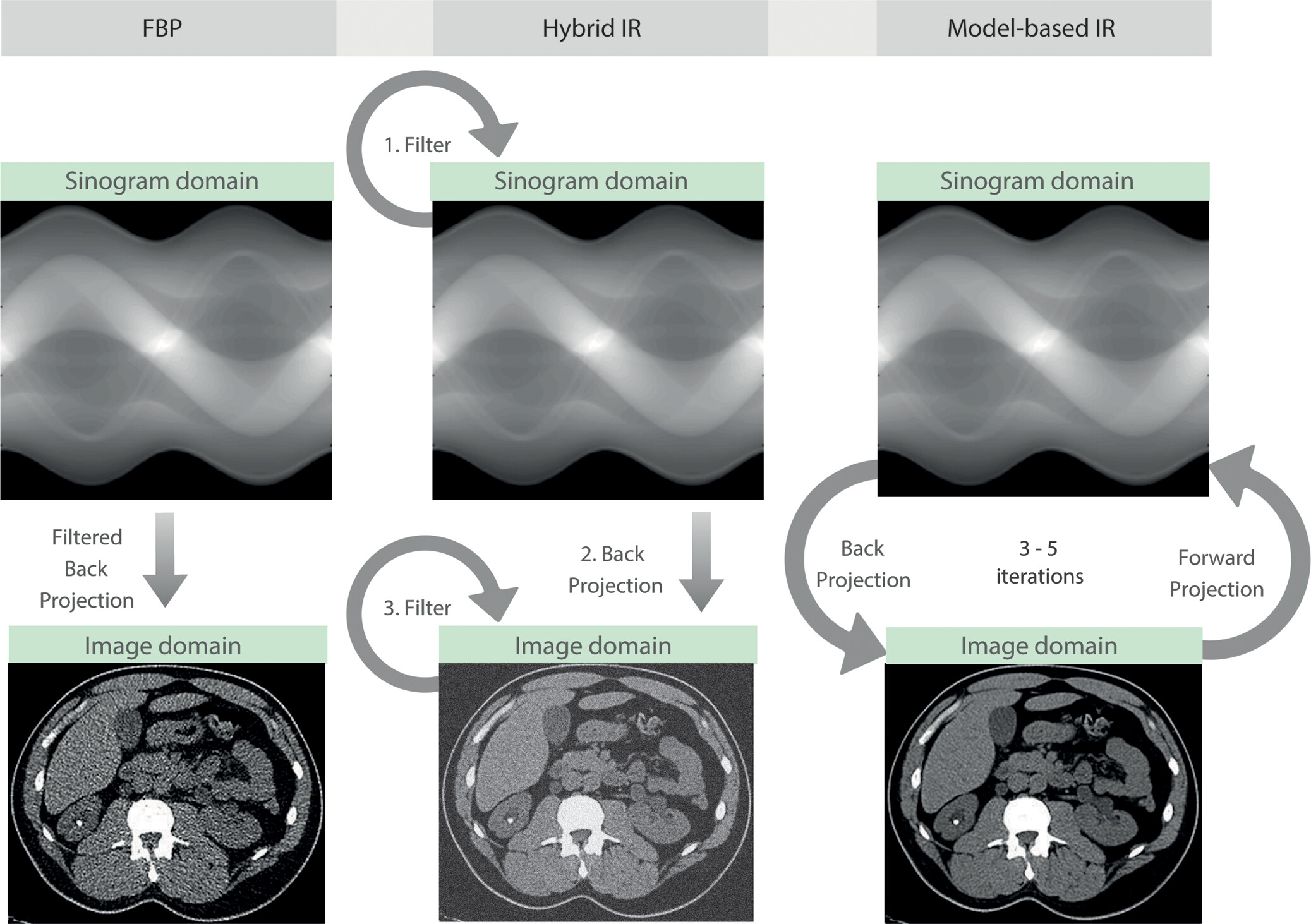
| Method | Speed | Noise Reduction | Artifacts | Clinical Use |
|---|---|---|---|---|
| FBP | ⚡ Fast | Low | High at low dose | Widespread |
| HIR | Moderate | Moderate | Moderate | Widespread |
| MBIR | 🐢 Slow | High | Low | Limited |
| DLR | ⚡ Fast | High | Low | Growing |
🤖 Deep Learning-Based CT Image Reconstruction
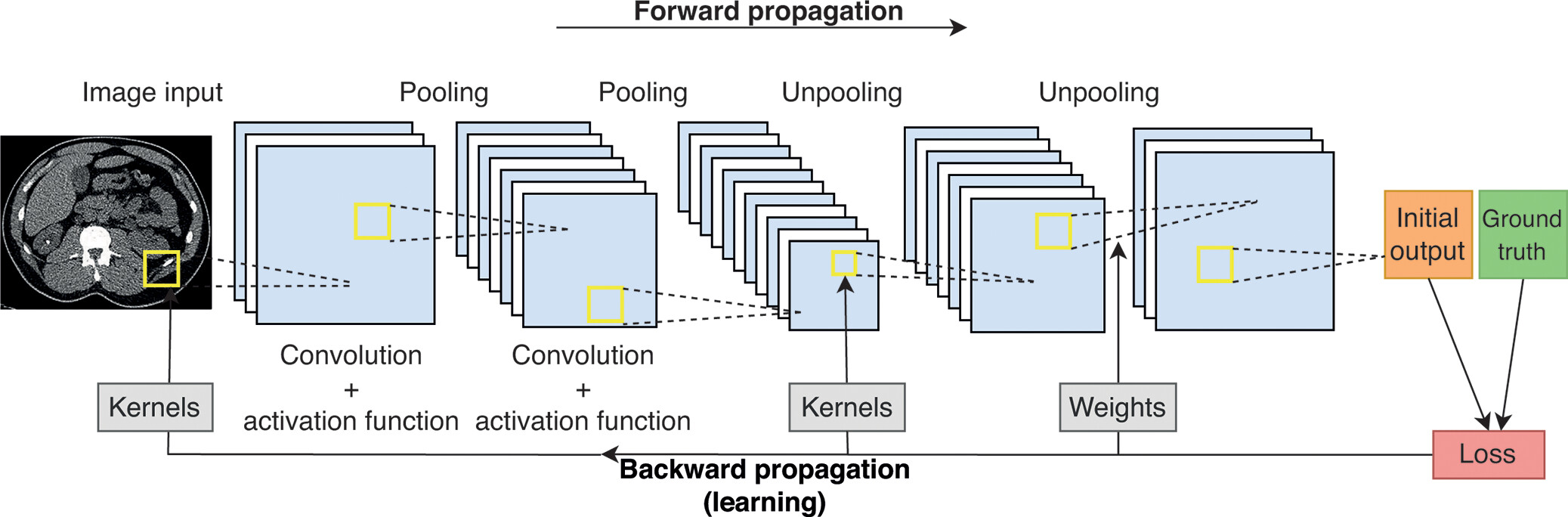
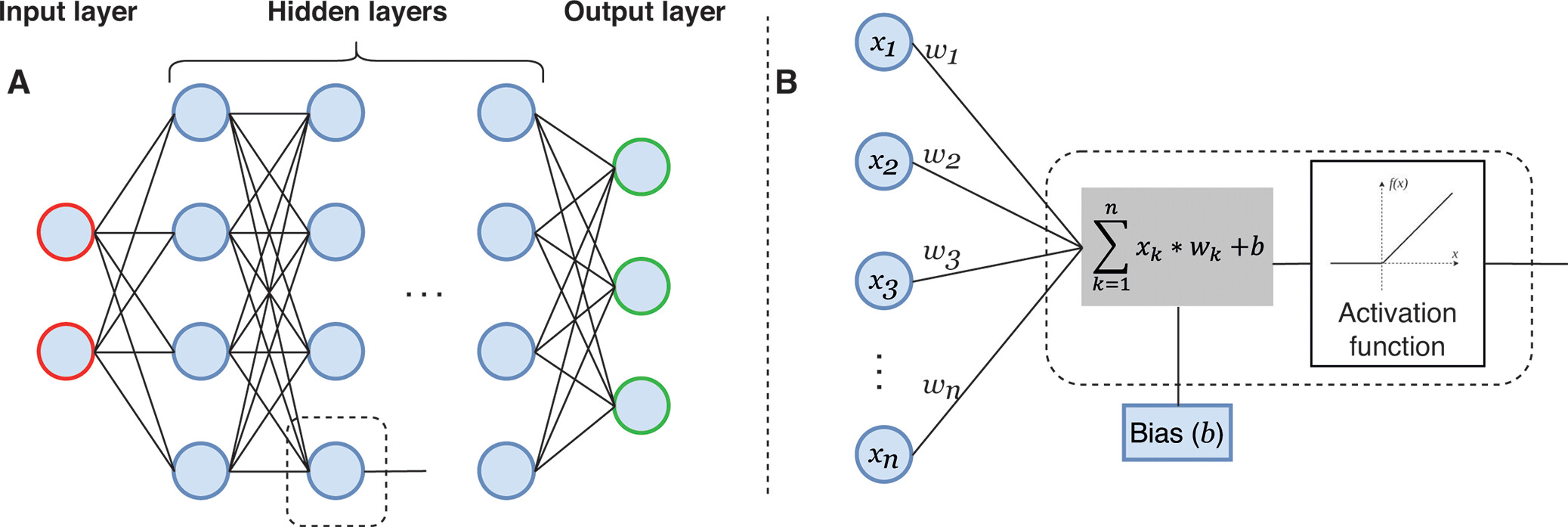
DL-based reconstruction methods group into two categories: indirect and direct DLR.
Indirect DLR Frameworks
In indirect DLR, either FBP or IR is used. Three sub-types, differentiated by when the deep learning network is deployed:
| Framework | When DL is Applied |
|---|---|
| Sinogram-based | Before sinogram undergoes FBP/IR (optimize raw data) |
| Image-based | After initial reconstruction with FBP/IR (optimize image) |
| Hybrid | Both sinogram and image optimization |
Common architectures: wavelet transform-based U-Net, residual encoder-decoder CNN.
Direct DLR Frameworks
Direct DLR algorithms reconstruct the sinogram directly into an image, without FBP or IR. This is only possible if the ground truth images used for training do not contain FBP- or IR-related artifacts.
Examples: AUTOMAP, iRadonMAP
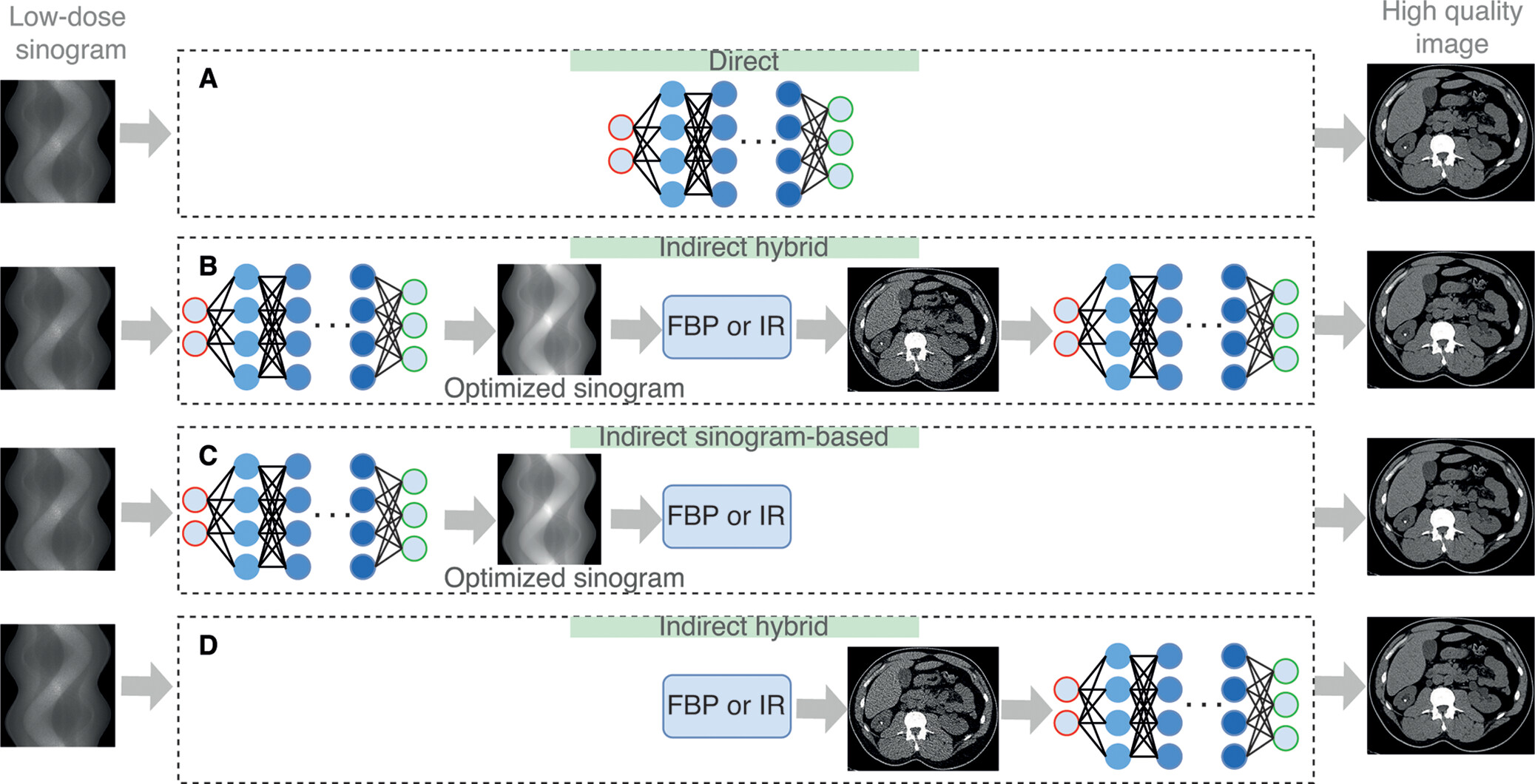
The detection and removal of artifacts in the sinogram domain are more efficient than image-based artifact reduction. Therefore, artifact reduction is expected to be better with direct > hybrid > sinogram-based > image-based methods.
🏗️ Building a DLR Model
A core component of DLR model development is the setting and tuning of hyperparameters (network structure, number of layers, activation function). These features must be established early because they cannot be learned during training.
Subsequently, the network undergoes training, validation, and testing phases.
Supervised Training
The use of matched data makes the training process supervised.
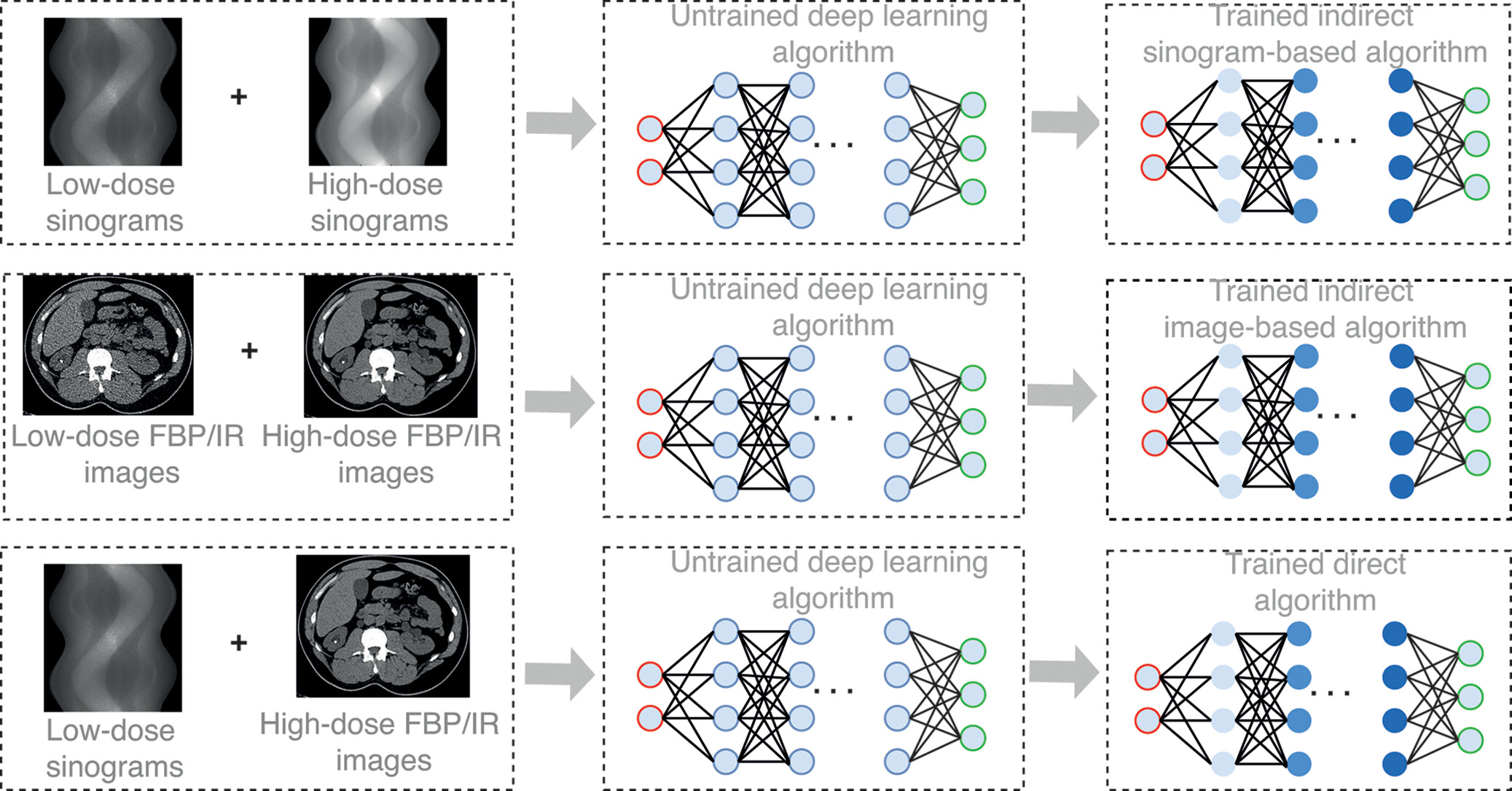
Ideally, DLR models are trained using:
- Input: lower-dose CT data
- Ground truth: routine-dose (2–4× lower-dose) or higher-dose (4–8× lower-dose) CT data
When DLR algorithms are trained on data with substantial artifacts as input and low-artifact data as ground truth, images can potentially be reconstructed with reduced artifacts — even beyond what the training data explicitly showed.
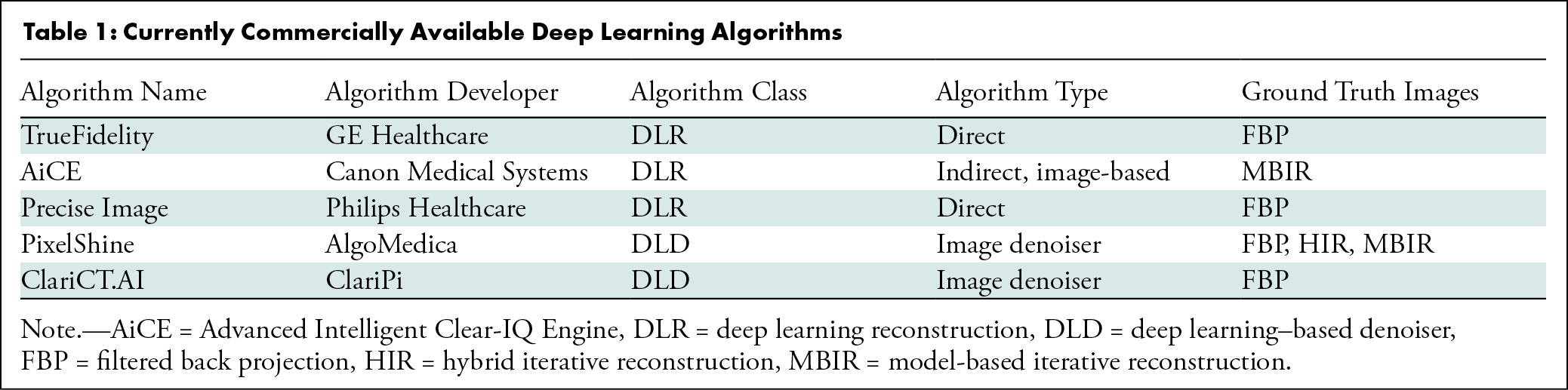
🏥 Currently Available Deep Learning Algorithms
🖼️ Image Quality of DLR
Image Noise
Content coming soon.
Image Noise in Routine-Dose Protocols
Image Noise in Lower-Dose Protocols
Image Noise in Thin-Section Protocols
Artifacts
Content coming soon.
Metal Artifacts
Content coming soon.
🩺 Clinical Applications of DLR
Brain
Content coming soon.
Chest and Cardiac
Content coming soon.
Abdominal
Content coming soon.
Pediatric
Content coming soon.
🔮 Challenges and Prospects of DLR
Challenges
Content coming soon.
Future Prospects
Content coming soon.
Part of my CT reconstruction literature review series. Next: deep learning CT reconstruction from incomplete projection data (sparse-view and limited-angle).